
Thinking Aloud About Game Design #5: Cliches and Tropes
Why we need to know the difference between the two

The most recent post in this series on Game Design mused on the importance of setting, theme, lore, and worldbuilding when considering the many challenges we face in designing RPGs. You might find this post makes a bit more sense if you read that one first— and here’s a link if you missed it the first time around.

I had some great comments (Thank you 😊), but one that particularly caught my eye was from zeruhur, the designer of the Loner games, talking about “tropes”.
Then I picked up my copy of How to Create Dark Worlds, by Angeline Trevena, where she discusses how tropes and cliches work in horror and dark fantasy.
I realised at that point that I didn’t actually know precisely what a “trope” was, nor how to differentiate between tropes and cliches…
Tropes and Cliches 101
Let’s start with cliches. When I think of cliches, my mind goes to the solo board game Final Girl.
If you’ve ever yelled at a horror movie screen because a character made an incredibly dumbass decision, Final Girl by Van Ryder Games is practically therapeutic. It is a solo game designed specifically to emulate the tropes, pacing, and sheer absurdity of classic 70s, 80s, and 90s horror cinema.
For example, in almost every slasher movie, there's a background pool of teenagers whose only purpose is to inflate the killer's body count. Final Girl represents this by scattering "Victim" meeples across the board!
Final Girl takes horror clichés—the doomed supporting cast, the apparently unstoppable killer, the last-minute weapon, the heroine finding her nerve—and turns each into a game mechanic.
That’s fine for the zany, wacky vibe of Final Girl. But it’s a long way from what I’m reaching for in my revamp of Blackoath’s Under Ashen Skies. Buy it’s a reminder of how tropes can become cliches if we overdo them!
A trope is a familiar storytelling pattern. A cliché is a familiar pattern that feels worn out through overuse.
For example:
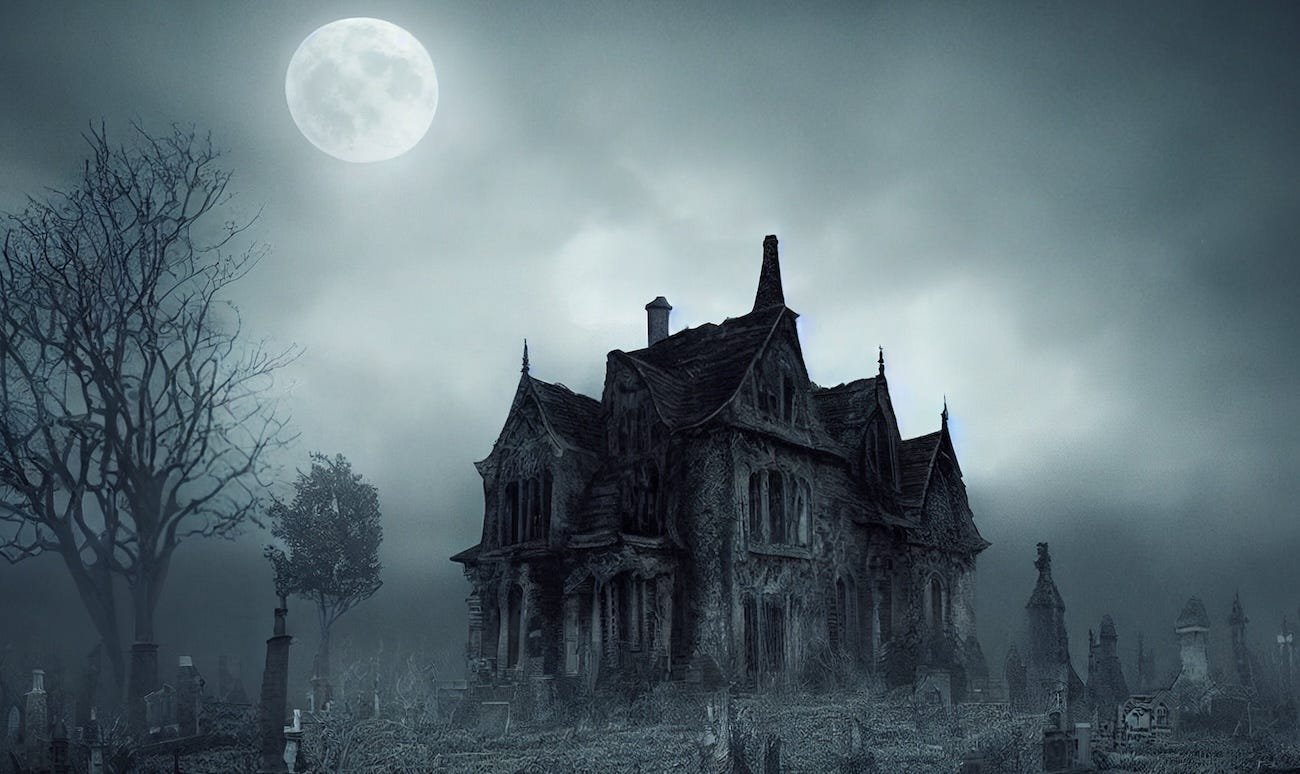
Trope: The group takes shelter in an isolated house during a storm.
Cliché: The phones stop working, the power cuts out, the car will not start, someone says, “We should split up,” and the basement door slowly creaks open on its own…. ***girl screams***
So the distinction is mostly about poor execution and over-familiarity. I found this quote floating around on the Internet (sorry, I couldn’t find the original source to give an attribution.)
Every cliché is a trope, but not every trope is a cliché.
Tropes are not a bad thing per se. Indeed, stories need them. They are part of the shared vocabulary between writer and reader—the narrative equivalent of saying, “You know the sort of thing I mean....”
But tropes tip over into clichés when we rely on them so much that they lose their surprise value or freshness and simply become boring and annoying. Final Girl “works” because it pokes fun at exactly this writing and design flaw, and goes way over the top in its execution!
So, should we not only steer clear of clichés but also avoid tropes? Not really. Well-used tropes connect our audience to the genre that we are setting our game in. How would anyone know that our game is a survival-horror/investigation TTRPG unless we employ at least some of the tropes that tell potential players what we are shooting for?
Tropes in Under Ashen Skies
Flipping back to How to Create Dark Worlds, Angeline has helpfully provided a pretty comprehensive list of tropes employed across horror, dark fantasy and grimdark—no less than 57 of them. Why 57, I ask? I’m sure it’s just random, but those of us of a certain vintage here in the UK immediately associate 57 varieties with a particular advertising and branding campaign from the 1970s. 👀

I read through the list a few times and thought about the elements that I’m designing into the reworked version of Under Ashen Skies.
I suggest that 11 of the Tropes that Angeline lists apply
Isolation. The player character is cut off from the wider world, with no reliable means of communication, escape, or rescue. Riverside feels less like an abandoned town and more like a sealed container. This isolation is intensified by the character’s amnesia, making us feel separated not only from others but also from our own history, identity, and sense of purpose.
Fog of Doom. A dense, unnatural fog surrounds Riverside, frustrating every attempt to leave. It is more than bad weather. The fog behaves like a boundary, turning travellers around, distorting distances, and making familiar streets feel subtly wrong. Beyond that, ash constantly falls from a darkened sky, coating buildings, vehicles, and people in a soft grey shroud.
Toxic Threats Riverside itself presents a constant danger. Its streets, buildings, and inhabitants have been twisted by whatever force has taken hold of the town. Threats do not exist only in obvious places: a quiet apartment or an abandoned shop may conceal something malignant. The environment is hostile both physically and psychologically. Merely remaining in Riverside is hazardous; exploring it is worse.
The Unseen Menace. Much of the horror in Under Ashen Skies comes from the sense that something is operating behind the visible events of the game. Some hidden intelligence or cosmic design seems to be arranging events from behind the curtain. Its presence can be inferred, but its full nature remains concealed until the endgame—assuming the player survives long enough.
A Dying World. Riverside does not feel like a town waiting to be saved. It feels like the final stage of an illness. Buildings rot, machinery fails, supplies dwindle, and the remaining inhabitants become increasingly desperate or inhuman. There is a persistent suggestion that the catastrophe may extend far beyond the town, and that Riverside is merely one small part of a world already slipping towards extinction.
The Eternal Night. Darkness is perpetual in Riverside. There is no reassuring dawn, no sunrise to reset the world, and no natural rhythm by which to measure the passage of time. This endless night erodes hope as effectively as any monster. Without morning, survival becomes an unbroken ordeal, and the player is denied even the comforting illusion that things may look better tomorrow.
Moral Ambiguity. Characters cannot be divided neatly into heroes and villains. Some may offer genuine help while concealing selfish motives. Others may commit terrible acts for reasons that are painfully understandable. The player character is no exception. Their forgotten past may contain choices they would rather not recover, and survival may demand further decisions that are difficult to justify. The game repeatedly asks not whether an action is good, but whether the player can live with it.
No Happy Ending. The story of Under Ashen Skies does not naturally bend towards a “victory” state. Its endings are likely to be tragic, unsettling, or incomplete. Understanding the truth may destroy whatever hope remains. Even apparent victory may raise doubts about what has really been achieved—or what the player has become in achieving it. The best ending may not be a happy one, but merely the least terrible conclusion available.
The Individual Struggle. The game focuses closely on the experiences of a single player character. Riverside may be suffering from a vast supernatural catastrophe, but the story is filtered through one person’s fears, memories, wounds, and decisions. The scale of the horror may be cosmic, but the struggle remains painfully personal.
Hopeless Resistance. Every act of resistance in *Under Ashen Skies* feels temporary. The player may delay the inevitable, uncover hidden truths, or refuse to surrender their humanity, yet the town constantly reminds them that survival is not the same as victory. Resistance may ultimately be futile—but continuing to resist may still be the only meaningful choice left.
A Lawless Frontier. Old laws have become irrelevant, and new rules are enforced through violence, fear, and control of scarce resources. Every district has its own dangers, every survivor has their own code, and disputes are rarely settled peacefully. The town resembles a frontier stripped of opportunity and hope: a hostile territory where civilisation has collapsed, but its worst impulses remain alive and well.
I was pleasantly surprised to discover that only eleven tropes from that rather enormous list really apply to Under Ashen Skies. Better still, several of them overlap, reinforcing the same core themes rather than pulling the game in a dozen different directions.
Had more than half the list applied, I might have started to worry. At that point, we’d be sailing perilously close to the rocky shores of Cliché Island—and nobody wants their game washed up there…
But eleven feels about right. Enough familiar ideas to give players something they instinctively recognise, while still leaving plenty of room to twist expectations and make those ideas our own.
So, what do you think? Does Under Ashen Skies feel like it is using tropes deliberately, rather than simply tumbling headfirst into cliché?
I definitely borrowed from familiar tropes when writing the game's setting, and I think it's a great way to immediately make a setting familiar to the reader/player. You're using a common language and it's easier to work from there as a starting point.
Not so much cliche. I felt more like borrowed ideas from ”Silent hill” and other horror games/settings morphed together with the created original ideas which made a clashing solo soup that is ”Under ashen skies”. I don’t know how you will take on this game and make it work procuderal and such but I know this game needs it :).