
Thinking Aloud About Game Design #4: How Important is "The Setting" in Solo TTRPG?
Lore, background and evocative setting in game design

Yeah, pretty much what it says in the title! How important is the setting, lore and narrative underpinning when it comes to game design?
When I first downloaded Under Ashen Skies and started reading, I was immediately captivated by the setting.
Imagine waking up in a place that feels vaguely familiar, yet completely alien, with absolutely no memory of who you are or how you got there. I mean, who wouldn’t be grabbed by that kind of premise?
Immediately, I was reminded of the opening scenes of the UK 1960s cult TV classic The Prisoner, conceived by and starring Patrick McGoohan (forget the utterly dismal 2009 remake). We see “Number 6” (we never learn his real name) waking up in a recreation of the interior of his home, located in a mysterious and inescapable coastal settlement known to its residents as The Village (actually the village of Portmeirion in North Wales).
It’s an idea that has been mined in many TV shows (Dark Matter, Lost, Dollhouse and currently From) and movies (Memento, Dark City, The Bourne Identity).
Under Ashen Skies takes this premise and twists it. Hard.
The authors, Alex T and Alan Bahr, blend the psychological tension of Silent Hill, the reality-warping metaphysics of Hellraiser, and the ancient, haunting echoes of Orphic-mystery cosmology.
Set in a modern-day East Coast town called Riverside, the game twists an ordinary community into a personal, atmospheric—and deadly—hell. We start our journey trapped in a world dominated by biting cold and an oppressive darkness, where our initial goal is to survive long enough to uncover the truth of our forgotten past.
Riverside itself has decayed into something truly surreal and hostile. The streets are desolate, and the few people we do cross paths with are unstable, cryptic, or entirely unhinged. The familiar, everyday spaces we take for granted—like hospitals, apartments, and gardens—have been warped into nightmarish versions of themselves.
To make matters worse, the town is periodically consumed by a wave of pure madness called The Devouring, a metaphysical event that plunges Riverside into a hellish mirror-world and suggests we are trapped somewhere between reality and a deeper underworld.
Is it a Purgatory? A Simulation a la The Truman Show? A Hellish Escape Room? All in our mind? Various characters we meet hint at those kinds of ideas, but the question is never resolved…
As we explore, we quickly realise that this isn’t just about fighting monsters; it is a journey of deeply personal horror where the environment itself reflects our own buried trauma. The ruleset weaves in mythic layers, allowing us to discover fragments of memory called Mneme, which we use to piece together our identity and advance our character.
But there’s another thing to consider: the past isn’t just out there waiting to be found—it’s actively hunting us. A unique and relentless foe known as our Nemesis stalks us across the map, serving as a terrifying, evolving manifestation of the sins and consequences we’d rather forget about…
As we slowly piece our identity back together, we might just find ourselves wondering if forgetting our past was actually a mercy. Ultimately, Under Ashen Skies balances survival and exploration with cosmic metaphysics and psychological symbolism, turning our own identity into the ultimate challenge.
Why Should We Care About Setting and Worldbuilding?
OK, I’ve fanboyed for about 500 words about the “world” of Under Ashen Skies.
I guess the first question to consider is: Does anyone care about any of that?
I don’t just mean for Under Ashen Skies, I mean for ANY game…
Would Ker Nethalas be a worse game if somebody (Alex T, I assume) hadn’t written 30+ lore-soaked blog posts on the official site? Would the Fallout games still “work” without decades of worldbuilding and lore?
Alternatively, would a barebones experience, such as Four Against Darkness, suddenly become more alluring if somebody produced a 400-page hardback lore book?
I think part of the answer relates to us solo players…
In a traditional group RPG, a GM acts as the ultimate lorekeeper of the world. They describe the smells of a tavern, invent a sudden plot twist when you roll a natural 1, and play the role of the cryptic stranger whispering in the corner.
In a Solo TTRPG, we obviously don’t have a GM. Because of this, setting, lore, and worldbuilding undergo a massive promotion—they step up to become the engine and the co-author of our story.
In solo play, we rely heavily on random tables, oracle rolls and prompts to determine what happens next. However, a random prompt like “You find a broken key” is entirely meaningless on its own. Strong worldbuilding provides the contextual filter through which we interpret dice rolls or tables.
Without other players to bounce roleplay off of, our primary relationship in a solo game is between our character and the world itself. When a setting is richly developed with specific mechanics—like survival rules for supernatural cold, gear decay, or a periodic wave of madness like “The Devouring” in Under Ashen Skies—the world ceases to be a passive backdrop. It becomes a living, breathing predator.
I’ve been around long enough now on Substack to know that one of the most common struggles in solo gaming is creative fatigue. If we have to invent every single detail of the world, every monster’s motivation, and every town’s history out of thin air while also playing the protagonist, it won’t be long before burnout comes knocking!
That’s where the setting comes in!
Deep, evocative lore acts as a creative safety net. When we flip open that lore book, it gives us a bit of scaffolding to lean on…
Ultimately, in solo design, lore is intimately connected to gameplay. A tightly bound “world” ensures that every loot drop (even when it’s randomised) and every dank, dimly-lit hallway (even when it's a procedurally generated hallway) feels like an intentional, atmospheric stroke of genius rather than a happy accident.
Fragments of Setting
When I first read through Under Ashen Skies, already aware of its Creative Commons status, I felt it would be good to try to build on the fragments of mythos, lore, and world of the game to create a coherent whole.
Maybe it's just me who prefers to have answers to the core questions a game raises. I dunno… but, at the end of the day, it’s my game revamp, so I’m following my own gut on this one!
I decided quite quickly to “lean in” to the Greek Mythological vibe. In the original core book, Greek mythology is present, but it’s mostly a buried bone rather than a visible structure.
The clearest explicit elements are the terminology: Mneme as the currency of recovered memory, Phonoi and Makhe as enemy categories, and the Protogenoi as powers governing Riverside, invoked through the shrine-building mechanic. Those names come straight out of Greek mythic vocabulary. So the original game is already quietly wearing a Greek mask under its ash-grey hoodie.
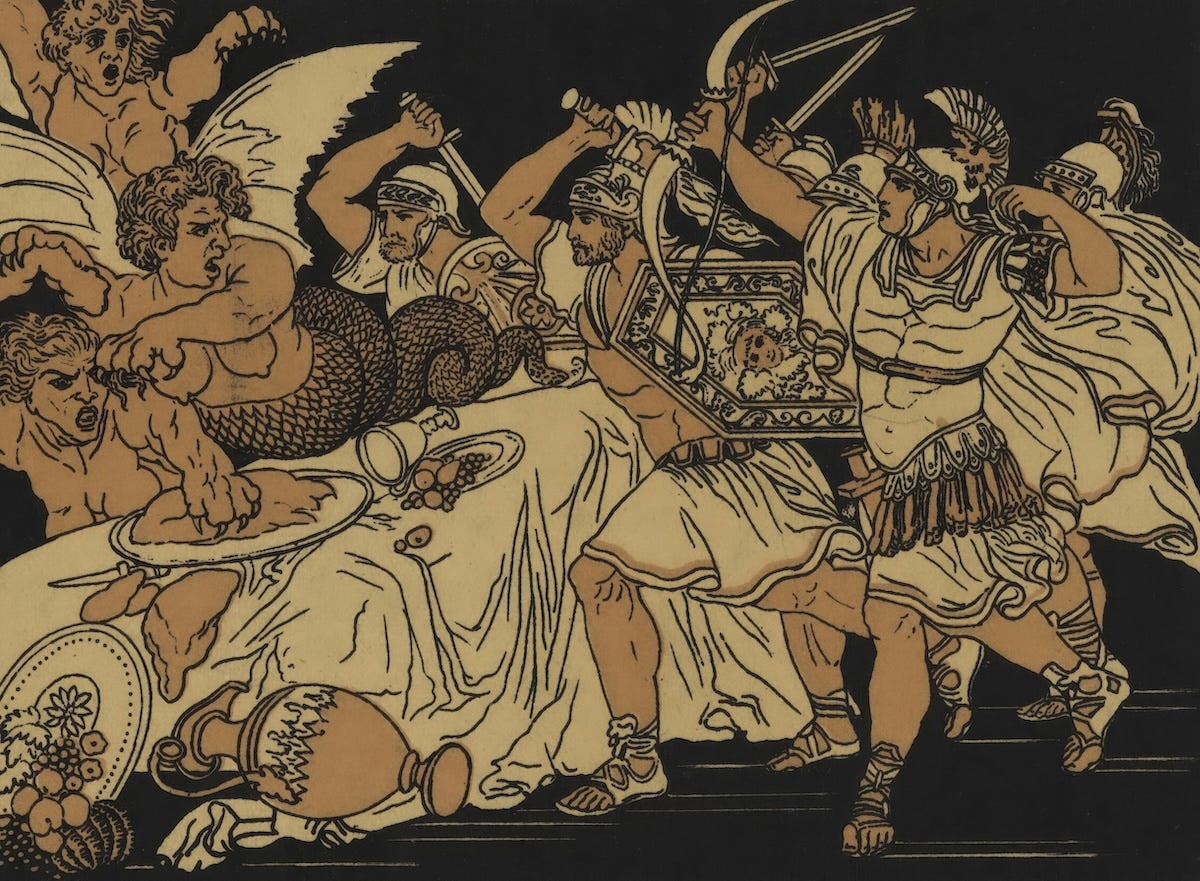
The deeper mythological structure is more implied than explained. The player wakes with no memory, in a deadened town they cannot leave, with only a lingering impression of having “crossed a river” recently; death is not a clean ending but a strange return to the apartment, sometimes costing memories, sometimes awakening new ones. Riverside, therefore, already has a strong underworld / purgatorial shape: the river-crossing, the loss of identity, the trapped souls, the repeated death-and-return loop, and the search for the self among ruins.
The Greek stuff is there like a skeleton under wallpaper: not necessarily obvious at first glance, but once you spot the knuckle-bones, you can’t unsee it.
Or I can’t anyway…
I feel like I want to push the Greek Mythology more—albeit keeping things a bit loose and vague, certainly at the start. Waking up as an amnesiac means that whatever Riverside is, we need to discover it gradually, through hints, clues, suggestions and conversations with NPCs.
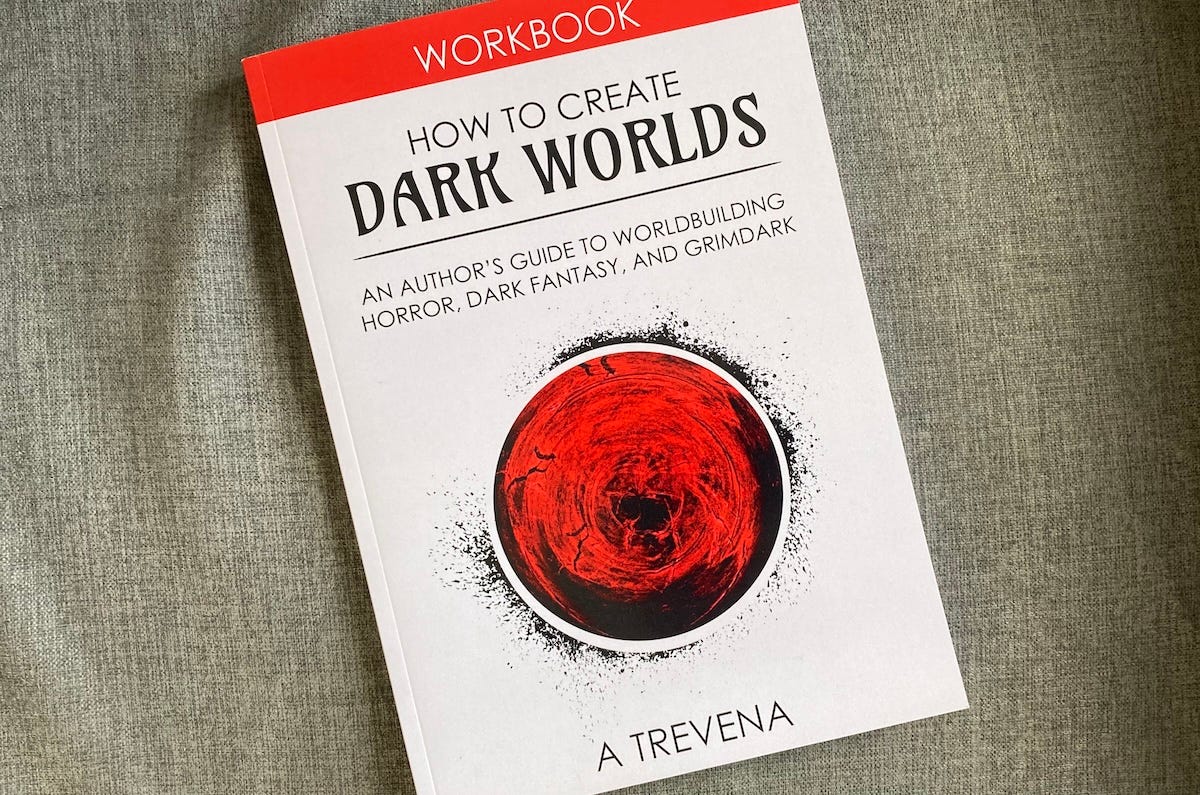
But it’s gonna be a bit more front and centre in my revamp. To help with thinking through this, I’m going to use some of the prompts from How to Create Dark Worlds, another in the series of Worldbuilding Guides by Angeline Trevena.
I’m not going to bore you with every last detail, but I’ll make a couple of update posts as the worldbuilding in Riverside continues apace over the coming weeks!
Again, thanks for reading and allowing me this space to “talk aloud” about this project. It really does help to be able to work this way 😊
I think it’s important with lore and narrative. But everything doesn’t have to be revealed on first page so to speak. It’s really interesting when parts of the lore gets into the light bit by bit. I think about games like Dark souls and such.
Lore really helps me in my solo gameplay, as you stated! Having something to draw on for inspiration is so important in solo play! I look forward to the lore you create for Under Ashen Skies revamp.