
The Weekend First Play: Loner
What I liked and what I didn't

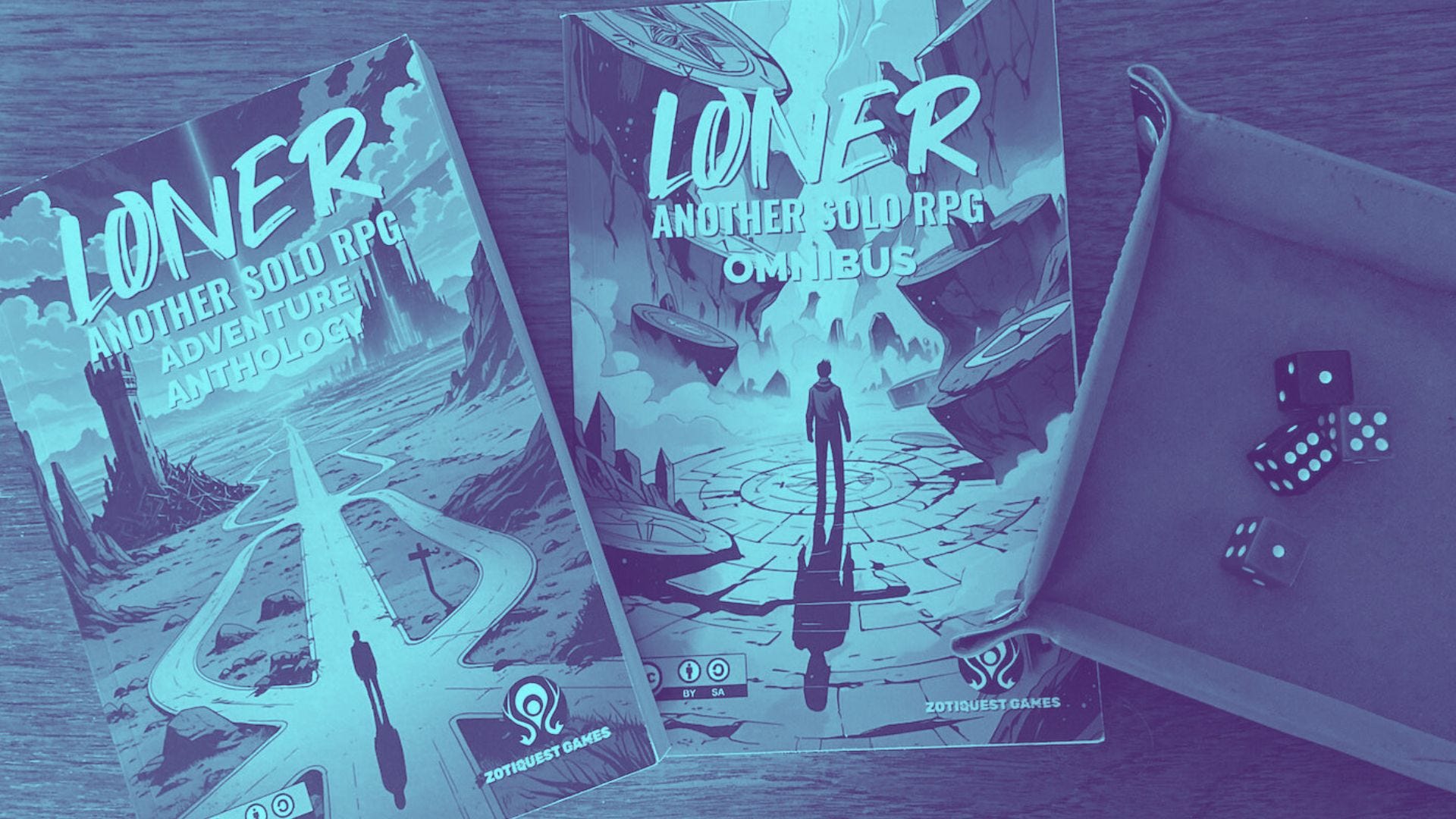
The first part of this overview of the minimalist solo RPG Loner looked at my first thoughts of the game “package”, which currently consists of two fairly chunky books.
A 250-page Omnibus containing the rules, together with chapters going into things in much more depth and separate sections on worldbuilding and character creation. Hence, Omnibus. It’s a handful of previously published booklets, updated and bundled into one book.
Then there is the second book, called Adventure Anthology, packed with tables, oracles, seeds and ideas for a dozen different genres of game.
It all kinda disguises the reality that Loner is a pretty simple game, with a few core mechanics and very little by way of “crunch.” Frankly, the game itself could be distilled down to an 8-page pamphlet! Everything else is optional.
I talked about how I created a character—a beautiful female spy thrown into a world of corporate espionage, a wave of misinformation and global cartels. Go back and read part 1 for what follows to make sense, because we are about to hurl ourselves into some gameplay…
What Sable Quinn Did Next
Sable wakes up in a hotel room with no memory of how she got there. There’s a datapad with news of a high-level assassination and a photo of the prime suspect. It’s her face in the picture! To make things worse, she’s wearing blood-stained gloves that she assumes contain the blood of the deceased diplomat.
And a drone is hovering outside the window, watching her every move!
She’s clearly been set up. But why, and by whom? She’s already checked whether the drone is active. It is. Whatever she does next, her captors will soon know about.

This is where things either get very creative or where things grind to a shuddering halt. It depends on how we handle the “what next” question! I turned to the chapter marked “Spy” in the Adventure Anthology, but didn’t find much to help in those 24 pages. Most of the section focused on character creation and adventure seeds—but it lacked guidance for once we started playing.
One of Sable’s skills is “Misdirection”, which is her ability to escape from tight spots by misdirecting those around and manipulating perception to gain advantage.
This looks like a potential advantage.
Sable looks across to the opposite wall and spots a grill covering what looks like a ventilation duct. If she can somehow distract the drone long enough, perhaps she can slip across the room and crawl through into the building’s system of ducts and tunnels.
The only item within easy reach is the datapad flashing with news of the assassination and the incriminating picture of her face.
I ask the oracle. If I throw the datapad at the window, will it confuse the drone long enough for her to make her escape? I decide my “Misdirect” tag gives me an advantage. I roll two Chance dice and one Risk die. The Risk die comes up 2, and the Chance dice come up 2 and 5. I discard the lower Chance die. Five plays Two. It’s a “straight” Yes.
Sable lobs the datapad into a conveniently sited plant near the window, the plant topples over, and the datapad crashes into the window, disturbing the curtains. Without waiting a second, Sable leaps for the opposite wall, pulls off the grill and crawls into the subspace.
Rappelling down the incline, Sable doesn’t stop until she reaches a junction in the duct. She knows that, by now, the drone will have refocussed on the couch and whoever is monitoring it will have realised she has gone…
Again, I ask the oracle. Does the duct lead to an exit? I decide that it’s a 50/50 roll. No advantage either way. I roll my Chance and Risk dice. I “win” by five to four. Both dice are over three, so I get a little advantageous bonus. I decide that Sable spots a panel that lifts to reveal a short drop to a service corridor.
Quickly, she scoots along the duct, lifts the panel and drops silently ot the floor—I mean, she isn’t called “The Whisper” for nothing!
Sprinting along the corridor, she spots a fire exit and hurls herself into the metal bar that goes across the door. Time for another oracle roll.
Is this Fire Escape operating normally? I decide that it probably is and grant myself an extra Chance die. I roll Risk=4, and Chance=4 and 5. I lob the spare dice back into the dice tray and take the win. The fire exit springs wide open with the force of her foot landing on the escape bar. Sable, blinking at the sunlight, finds herself out on the street, poised like a cat and ready for her next move…
I played Sable’s story for a bit longer as she jumped into a taxi, only to learn that she was in a strange city. Realising she must have been drugged, she asks to be taken to the nearest hospital in the hopes that someone will be able to determine what drugs are still in her system. Maybe that will be a clue to identify her kidnappers?
But you don’t need to see that played out—you get the idea of the gameplay loop from what I’ve written.
Assessing Loner: Another Solo RPG
Let me start with the positive. Once I got to grips with what I was looking at in the chunky Omnibus, it wasn’t hard to understand the gameplay and mechanics. I spent more time looking for the (non-existent) “crunch” than learning how to play.
Loner is a straightforward, zero-crunch, minimalist solo-only RPG. I feel like claiming not to be a journalling game hurts its potential audience. The mechanics are so simple that using the system to journal a story seems like a worthwhile exercise.
And there lies my misgivings with Loner. It felt like I was writing a story rather than playing a game. Roll some dice to see if my hoped-for method of escape would “work” for Sable. I passed, so I progressed to the next flex point of the story.
What would I have done if my roll while sitting on the couch had failed? Well, I’d have to try something else and hoped that would work. Because I didn’t have any other mechanic to drive the story forward, and I’d just be left sitting there…
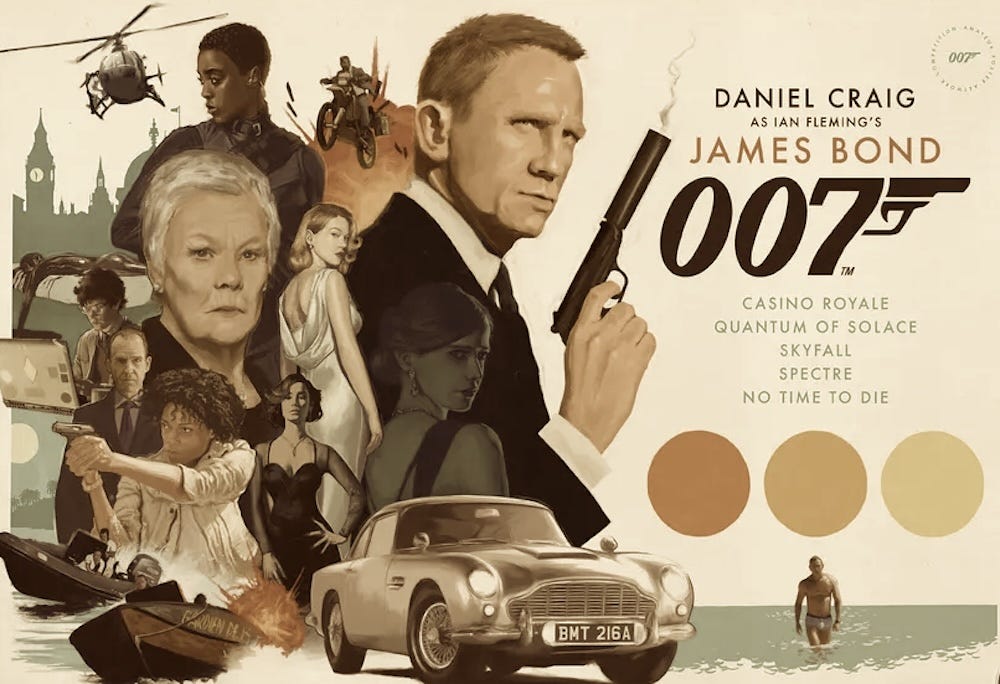
It felt a bit like I was trying to think of the next clever way to pull out some kind of unlikely “victory from defeat”—which actually chimed quite well with the James Bond-esque vibe that I was going for. After all, 007 ALWAYS has some unlikely method of escape, even when it seems all is lost.
But when what I’m doing is thinking up the next “MacGuffin” to throw into the game to create forward movement, am I playing a game or writing a story?
noun: MacGuffin: an object or device in a film or a book which serves merely as a trigger for the plot.I hope it doesn’t sound too negative, because I think Roberto has pulled off something special here—working on his lonesome AND in a foreign tongue. All kudos to him.
I don't know, perhaps the lesson I learned is that I prefer games with a bit more crunch, a few more mechanics, and a pre-existing lore and world to explore. It got me excited to dive into some of the crunchier games on my shelf. I think my capacity to “make up lore as I go” disappeared in the wake of my cancer diagnosis last year and the chemotherapy which followed. Somehow, I don’t have the brain capacity to do that kind of thing anymore…
And that’s OK. Not every game is right for everyone. Not everyone has to like the same things. I see people over on Reddit waxing lyrical about Loner, and I’m pleased that’s the case.
But I don’t think it’s a game for me, and what I’m looking for from a game system. I’m sure I’ll break out Loner from time to time. It’s an excellent option for slipping into a travel bag for a night away, a holiday or a spell in hospital…
So, dear readers, have YOU played Loner: Another Solo RPG? What did you think of it, and what would you suggest that I might try next time?
In fact, how about we make this into a poll: Which game currently sitting on my shelf of shame should be the next “Weekend Play?”
Vote, vote, VOTE…in the poll below—and thanks, as always, for reading!
Hi Paul,
Thank you so much for taking the time to play Loner and for writing such a thoughtful review! I truly appreciate your honest feedback, especially given the challenges you've faced this past year. Your health and well-being come first, and I'm genuinely glad you found the game portable enough to consider for travel or hospital stays.
I wanted to address your central observation about Loner feeling like "writing a story rather than playing a game." This is actually a fascinating point that touches on what makes Loner different from both traditional RPGs and journaling games.
Loner isn't designed as a journaling game or creative writing tool: it's built around emergent narrative. The key difference is this: in creative writing, you're the author making all the decisions. In Loner, the Oracle and the Twist Counter are specifically designed to subvert your expectations and push the story in directions you wouldn't choose yourself.
When you rolled to see if Sable's escape would work, you weren't just writing "what happens next", you were genuinely asking a question whose answer you didn't control. That's the game element. The Oracle could have said "No, and…" forcing you to deal with the drone discovering your deception, or "Yes, but…" meaning you escape but leave behind critical evidence. These outcomes would have surprised you and forced adaptive play rather than authorial control.
I completely understand your point about crunch, and you're absolutely right that Loner deliberately minimizes it to keep the focus on Fiction First and Fictional Positioning. The "game" in Loner isn't in tactical complexity but in the tension between what you hope will happen and what the Oracle reveals, amplified by the Twist Counter building toward narrative disruptions you must navigate.
Your experience with Sable actually demonstrates this beautifully: you made choices based on her traits (Misdirection), the Oracle determined outcomes you didn't control, and the story emerged from that dialogue between intention and result. That's emergent narrative at work: different from both predetermined story outcomes and pure creative freedom.
That said, not every game is for everyone, and that's perfectly okay. Your preference for more mechanical depth and established lore is completely valid. Games like Ironsworn or Starforged might offer that middle ground: more crunch while still supporting solo play.
I'm genuinely grateful you gave Loner a fair try and shared your experience so thoughtfully. Reviews like yours help other players understand whether the game matches their preferences, which is incredibly valuable to the community.
Wishing you all the best with your gaming adventures, and I hope you find the perfect system that brings you joy!
Warm regards,
Roberto
Thanks for writing this review. Loner is one of those items on my "to buy" list and I'm glad to see an example of what it can play like.
For the poll, I voted for the Across A Thousand Dead Worlds, but I'd also like to see Achtung! Cthulhu. I just started playing that one myself, and I'm curious to see another solo take on it. It is VERY crunchy!