
The Weekend First Look: Loner
I finally got this one to the table

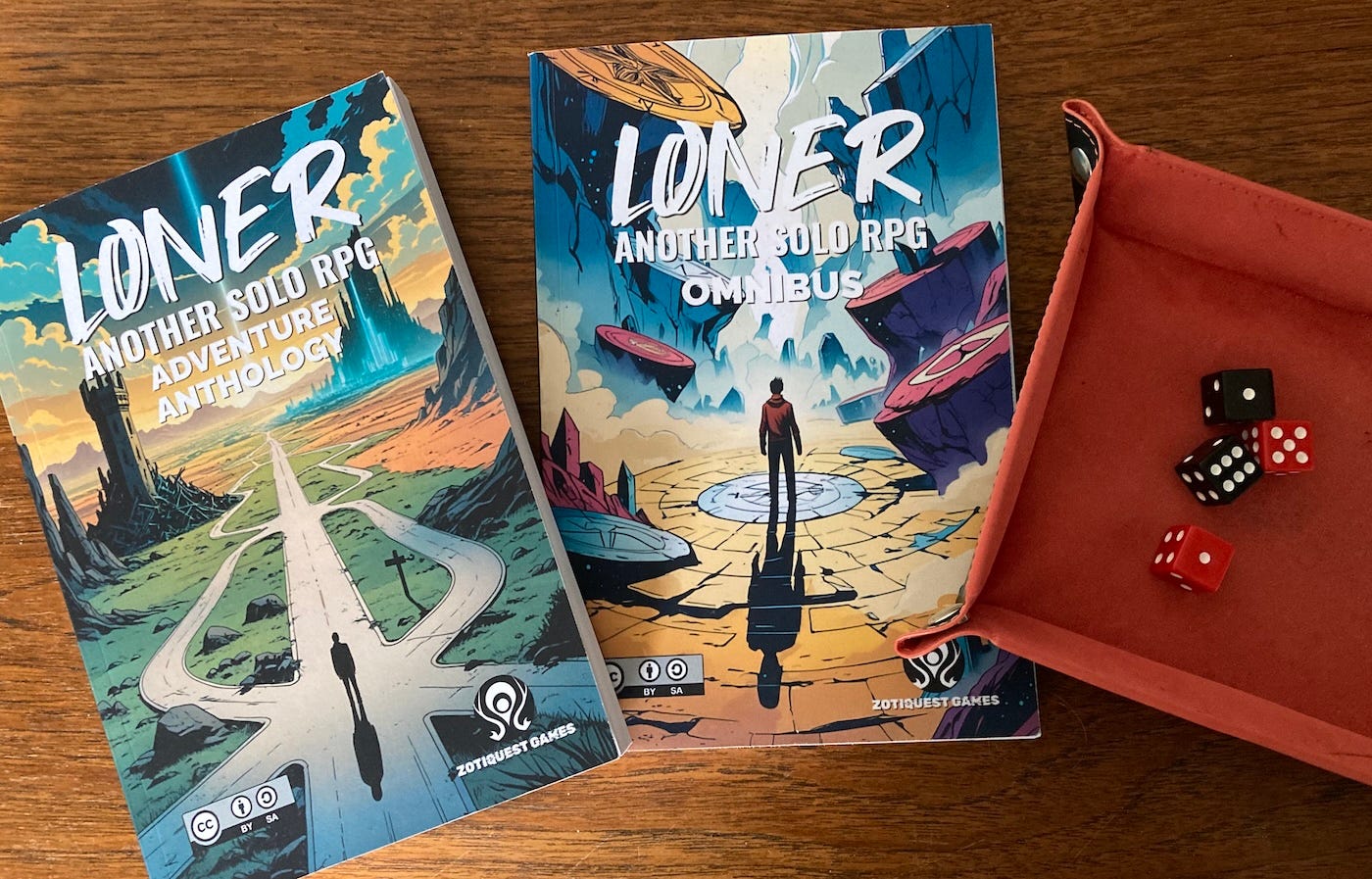
I’ve had a bit of an odd relationship with Loner. I’d seen lots written about the game, and it was recommended as a beginner-friendly game. I was excited that a new 3rd edition was coming out—and purchased it on release.
Since then, the core book, Loner, Another Solo RPG Omnibus, has travelled to Italy in my travel bag, and later it cruised around the Norwegian Fjords—and I never managed to progress much beyond the first few pages.
Why was I finding it so hard to get to grips with what everyone on Reddit refers to as one of the lightest and most accessible games for inexperienced players?
I’m sure that part of it is that, whilst also being heralded as “light,” the Omnibus runs to just over 250 pages, whilst the companion Adventure Anthology weighs in at just shy of 300 pages.
Now, I’ll grant you that most of the Adventure Anthology and some of the Omnibus consist of oracle tables. But there’s still a big chunk of reading material to plough through for a game often touted as beginner-friendly.
This week, I decided to commit to Loner, read the rules, and actually get the damn thing to the table. How did I fare?
Loner. Another Solo RPG
Loner began as a game written entirely for its designer, Roberto Bisceglie, an independent game designer, translator, and editor who works in the Italian role-playing game scene. Roberto told the Geek Native website.
“I write the games that I want to play but no one else writes.”
Kudos for bringing something new to the scene, Roberto, when so many re-tread well-worn paths. It’s also worth noting that Roberto, who writes here on Substack under the moniker zeruhur, is a native Italian speaker. English is his second language, and I’m always blown away when someone produces something not in their native tongue.
If you find the occasional typo, and I have spotted a couple, I remind myself that Roberto’s English is infinitely better than my Italian!
The motivation behind Loner is to have something minimalist and flexible. It is natively solo with a small rule set, allowing players to build worlds with simple tools.
The game’s core idea is simple. We build a story from prompts, using “tags” rather than traditional skills, attributes or hit points. Dice rolling serves only as an oracle to make decisions. There are no rules to “win,” only moments to explore. Each roll or choice shapes how our story unfolds.
A simple gameplay loop
The fact is that, whilst the two books weigh in at over 500 pages, the core rules and play loop could fit onto a few pages.
Paradoxically, I think one of my struggles with the rule book (Omnibus) was kinda “overthinking it.” I was reading page after page and looking for the “crunch” of a typical RPG ruleset. But there isn’t one. There is a straightforward character creation and a single oracle mechanic using no more than four dice (more often it’s only two).
And that’s about it.
Everything else happens in our imagination. The Omnibus says that the game isn’t meant to be a journalling game—but, honestly, I think it’s better thought of as falling into that sub-genre. With the character sheet being as simple as an index card, and four dice to hand, there’s not much for us to “play with” if we are at least writing down the salient points in the journal. But that’s maybe just my view—you might be content with “the theatre of the mind.”
Let’s create a character.
It’s probably easier to demonstrate character creation rather than try to explain it. Loner is genre-agnostic, meaning we can create a character in any world, real or imagined. I decided to jump into a 1970s-inspired spy scenario where suave, suited British spies, toting a revolver, save the world whilst playing blackjack, looking cool and always having an impossibly attractive woman on their arm.
Now, the Adventure Anthology—which essentially consists of tables, oracles and adventure seeds for a dozen different worlds—contains a chapter for roleplaying a spy, so we have that to fall back upon.
However, I decided to dive in and create a character from scratch, drawing on some ideas in my head, and I used a little bit of AI prompting when I got stuck. The idea was to create a femme fatale spy who specialises in stealth, infiltration and misdirection, loosely based on the lead character in the noughties American show, Alias.
This is what I came up with, after typing it into a Word doc and printing it out so I could keep it in front of me for guidance during play.
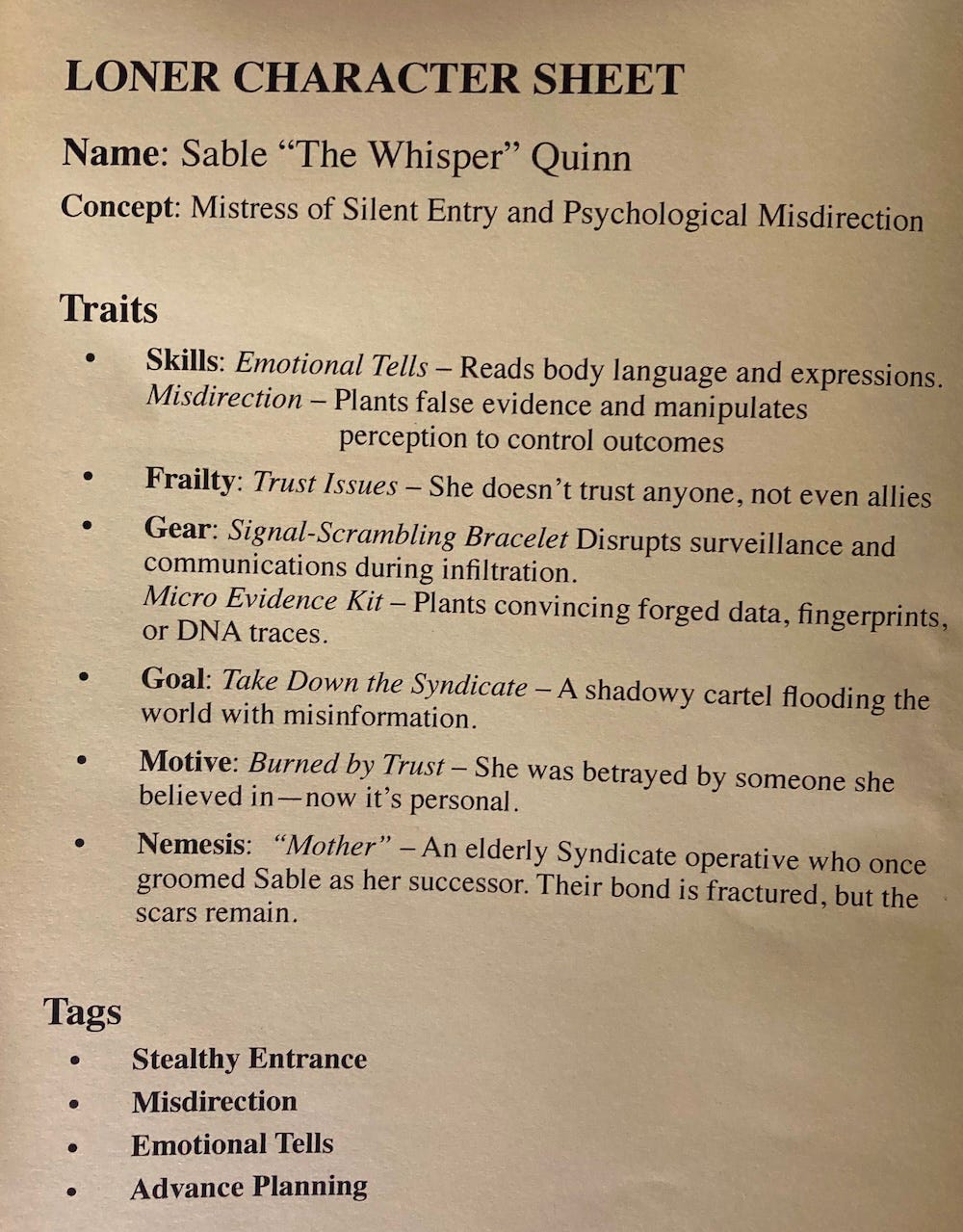
We choose two “skills” and one frailty, before selecting two pieces of starting gear. Then we envision a goal, a motive and a nemesis. From all that, we then choose a few “tags”—which are words or short phrases we use in the game to gain advantage (see later) with the dice.
As I say, all of this character creation could equally well be done through rolling on tables, and I might do that next time around just to see how that mode works.
Now what?
Here’s where things got a bit trickier. It’s easy enough to envision or roll a character. But the game lacks scenarios, quests, stories, and even a coherent world with lore and plot seeds. We have to “envision ourselves into the world” that we haven’t yet created, allowing it to unfold as we play.
This is where Loner diverges from a game such as Ironsworn, where we take time to envisage our “World Truths” before we start.
OK, I decided to throw Sable into the middle of the action, in media res, as they say. I decided she wakes up in a hotel room, with a datapad showing the latest news story, which is about the assassination of a prominent diplomat. The picture on the screen is hers! She’s wearing gloves she has never seen before, stained with blood (she surmises they belong to the dead diplomat). She is being framed—she doesn’t know by who, or why…
To make matters more complicated, a drone is hovering outside the window, and her phone is missing. She’s on her own, and she’s being watched, it seems…
OK, so Loner’s “mechanics” (such as they are) consist of an oracle roll. We roll 2d6, where one colour is our “chance” die and another colour is our “risk” die. We need an additional die of each of the two colours we’ve chosen; they come into play when we have advantage or disadvantage in our roll.
We ask “closed questions” and roll the two dice. So I ask, “Is the drone outside the window showing signs of being active?” My “chance|” die is 5, my “risk” die is 3. It’s a “yes.” Furthermore, in Loner, when the two dice are BOTH equal or greater than 3, that is a “Yes, and…”
So, I think and decide that as soon as Sable stands and moves towards the window, the drone begins to beep insistently. She won’t be able to leave the room without triggering the drone to alert whoever is monitoring it.
A word about the oracle.
When we roll the 2d6, we can have seven different results:
If the Chance die is greater than the Risk die, then it’s a “yes”… but additionally…
If both dice are three or greater, it’s “yes, and”. You have a bonus
If both dice are under three, it’s a “yes, but”. There is a drawback
If the Risk die is greater than the Chance die, then it’s a “No”…but additionally…
If both dice are three or greater, it’s “no, and”. There are additional negatives.
If both dice are under three, it’s a “no, but”. There is something positive.
Additionally, if the dice are equal, you add one to a Twist Counter (major event triggers when this reaches three)
It looks complicated at first, but honestly, it falls into place within a few rolls.
But what about the second dice, Paul? Ah, glad you asked! This is where “tags” come into play. If you try something that chimes with one of your tags, then you are at an advantage, which means you roll TWO Chance d6s and discard the lowest.
This simulates having the advantage in that scenario due to our skill set. Conversely, something where it seems like the opposition would have the edge, or where your frailty comes into play, you roll two Risk d6s (and discard the lowest).
It’s quite an elegant way of introducing levels of chance and risk into what is a deceptively simple d6 dice pool.

One thing that’s a little unusual in the system is the philosophy of “everything is a character.” It means that any person, place, object, or force in our story is treated like a character—with its own tags, skills, and frailties. This reframes the entire world as a web of personalities and agendas, not just scenery or props.
We are encouraged to see tags as, in the words of the Omnibus, “narrative signposts.” They aren’t “hard” skills like in traditional RPGs, and we don’t have numbers for skills, attributes, attack, defence or even hit points. But they do direct the flow of the story as it unfolds.
That’s both a simple, elegant way to play AND a potential problem for some players. But I’ll get into that in the second part of my overview of Loner, when we get into describing some gameplay. Check back tomorrow for part two…
As much as I love to play this by myself, I can see this being used in a group setting even in a GM less game.
"We have to “envision ourselves into the world” that we haven’t yet created, allowing it to unfold as we play."
This is the same thing we have if we choose to homebrew a game using MythicGME for a lot of the game. And that is what is so fun about it!