
The Weekend First Look: Iron Valley
Exploring a cosy remix of the Ironsworn TTRPG

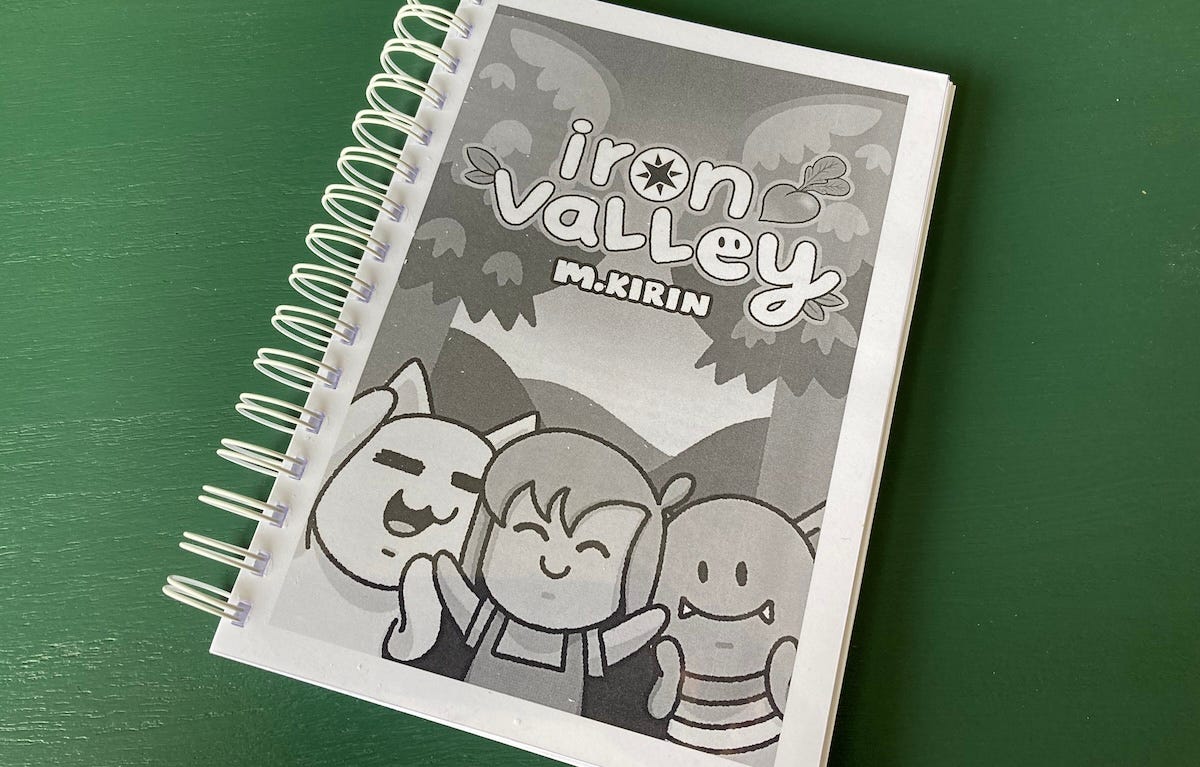
If, like me, you’ve ever wandered the windswept, wild Ironlands in Ironsworn, forging vows in the face of peril and hardship, then Iron Valley might feel like stepping into an idyllic paradise you didn’t know existed.
Created by M. Kirin, Iron Valley is a solo TTRPG that reimagines the core mechanics of Ironsworn (and Starforged) through a lens of warmth, community, and cosy storytelling. It’s a “hack” in the truest sense—not just a reskin, but a reinterpretation of what it means to play a narrative-driven game powered by promises, progress, and personal stories.
At first glance, Iron Valley shares much with its progenitor (that’s a big word for a Friday afternoon 😛). You’ll still find the familiar rhythm of moves, the regular roll of d6s and d10s, and the ever-reliable oracle tables that spark creativity when the story flounders.
But where Ironsworn is a game of survival and grit, Iron Valley is a game of growth and gentleness. It swaps the iron-shod boots of the adventurer for the muddy shoes of a farmer, a shopkeeper, or a newcomer hoping to find their place in a small, welcoming town.
Don’t look for “hit points”—this is the first game I’ve played since discovering solo TTRPGs where you cannot die. Yes, that’s right. You don’t ever kill or even attack people in this game; indeed, the worst that can happen is losing track of time…
One of the most noticeable differences is the tone. Ironsworn is based on tension: every vow is a risk, every journey a challenge. You could meet a grisly end with a single misstep. Iron Valley, on the other hand, focuses on comfort. The main mechanic centres around promises, but these are not oaths sworn in desperation—they’re intentions made to friends and neighbours. Things like “I promise to help my neighbour fix their roof” or “I promise to bake a pie for the town festival.” The stakes are emotional rather than life-threatening.
The premise is delightfully straightforward: you’ve just moved to the Valley. Perhaps you’ve inherited a neglected farm, or maybe you’re settling down after years of wandering. The game encourages you to build your life gradually, cultivating relationships, exploring the surrounding wilderness, and helping shape the town through your choices.
People tell me it’s Stardew Valley meets Ironsworn with a touch of Animal Crossing thrown in. I’ll have to take that on trust, ‘cos I’ve never played either game.
Mechanically, Iron Valley simplifies the move structure. There are fewer moves to learn—just ten—and they’re designed to be intuitive and low-friction. You’ll forage, trade, gift, and receive gifts in return. You’ll raise livestock—some familiar, some fantastical (Beaver Weavers and Chillachonk, anyone?)—and unlock “heart” events with townies as your relationships deepen. Time passes in a structured way, with each action advancing the clock and each day offering new opportunities. It’s a life sim in tabletop form, but with the narrative richness and improvisational freedom that Ironsworn players will instantly recognise.
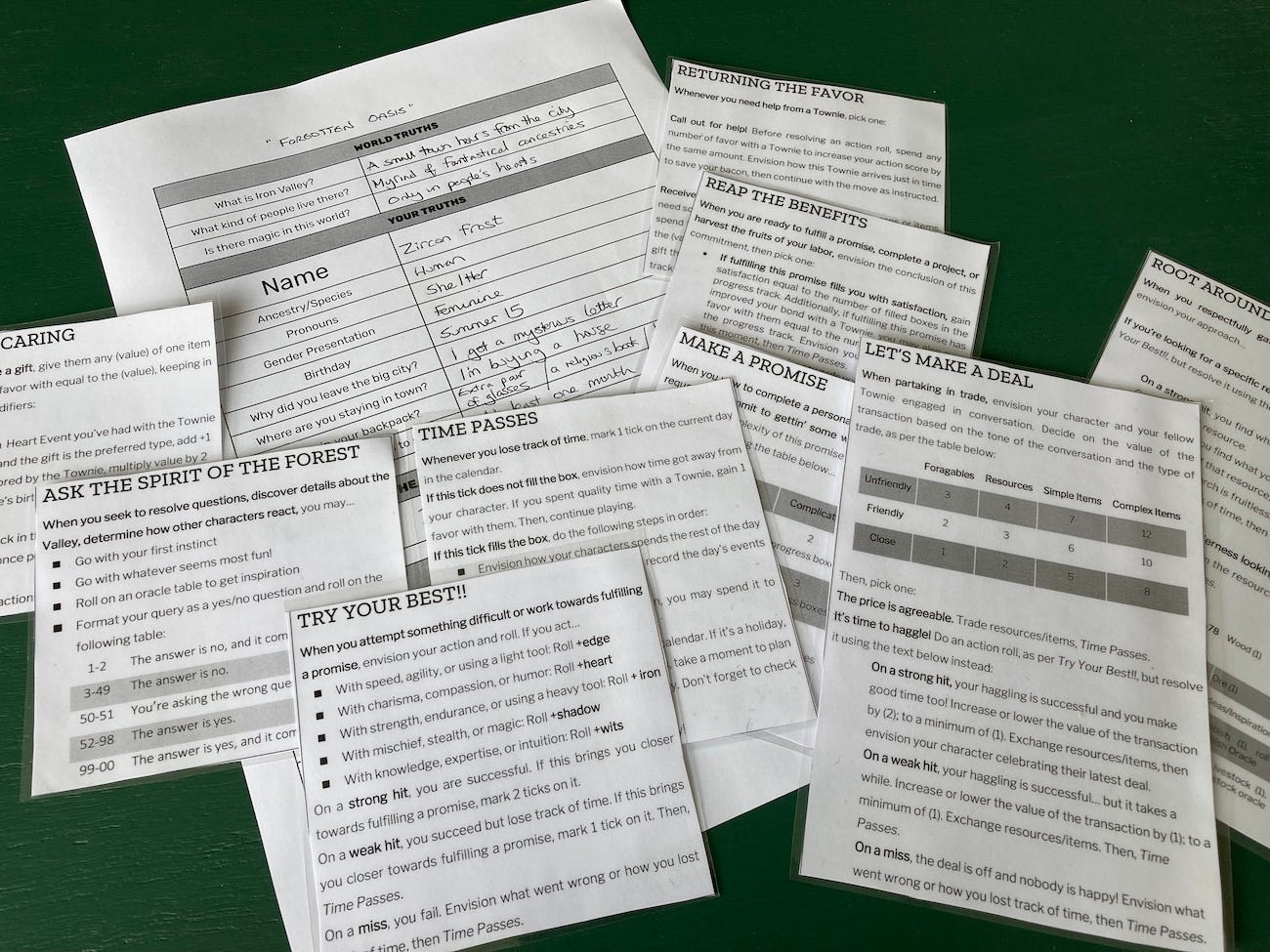
What’s particularly clever is how Iron Valley maintains the spirit of Ironsworn’s “truths” mechanic. Before play starts, you define the nature of your Valley. Is it a medieval village or a modern rural town? Are the inhabitants humans, anthropomorphic animals, or something entirely different? These world truths shape the flavour of your game and provide a framework to build upon. It’s a nod to Ironsworn’s world-building tools, but much simpler for a gentler style of storytelling. You can even randomise the entire character creation process.
With that said, how about we do just that?
Since the Iron Valley book provides oracle rolls for every aspect of character creation, I decided to go “full on random”—starting with the name of my settlement, which ended up as “Forgotten Oasis.” Not too shabby!
OK. World Truths. We have three options: a generic D&D-style fantasy world, a broken version of today, or a future colony on a distant planet. I roll a 47. I find myself in a bustling town that has fallen on hard times. It is populated, I learn, by “a myriad of fantastical creatures,” for example, I might meet friendly orcs, elves, vampires or even zombies! Options were a human-only world or a land of anthropomorphic animals.
Finally, we need to decide about magic in the world, and the dice go high this time—the only magic in this world will be “in people’s hearts.”
My name, as the gods of the dice decreed, will be Zircon Frost, a human, with pronouns she/her (Yes, you can randomise pronouns!). My birthday is “Summer 15”, i.e., the fifteenth day of the Summer season, since the game eschews months in favour of seasons.
I left the big city because I received “a mysterious letter”, and that came with a quest seed to discover who sent the letter (and, presumably, why). I possess a backpack with a somewhat bizarre collection of items: an extra pair of glasses, a religious book, and a large can of energy drink.
So I’m a religious nut who has poor eyesight and problems staying awake!
Where am I staying in town? Options include an inherited farmhouse, staying with someone in town, or purchasing a house from a current owner. I end up with the latter. I will need to get a job to keep up the payments.
Then we get to think about Skills, which substitute for Assets from the Ironsworn big brother game. Again, I go for the random approach—and end up with tailoring, foraging and barter. Interesting…
Putting it all together:
I’m a human female in a town with a rich variety of species.
I came in response to a mysterious letter (but who was it from?)
I’m buying a house in town and plan to stick around, which means I will need to find a job. I’m skilled with tailoring cloth, so maybe that’s an avenue for employment?
I’m good at foraging. Can I be self-sufficient? Either way, I can barter for stuff I need.
It’s plenty to be getting on with…
The last thing I need to do before getting started is to pick my attributes. These follow the tried-and-trusted Ironsworn format of Edge, Heart, Iron, Shadow and Wits. These are distributed in the 3,2,2,1,1 (I didn’t see the alternative that Lodestar offered). With no need for combat or subterfuge, I went:
Wits 3
Edge 2
Heart 2
Iron 1
Shadow 1
And with that, we have our character ready to arrive in the Iron Valley. So what did I think?
Final Conclusions
For players familiar with Ironsworn, Iron Valley offers a fresh change of pace. It’s not about danger and despair — it’s about connection and caring. Yet it still honours the core appeal of solo TTRPGs: the joy of discovery, the satisfaction of progress, and the intimacy of telling a story that’s entirely your own. It’s a game that asks, “What if the most heroic thing you could do was show up for your community, day after day?”
In a hobby often characterised by epic quests and high-stakes drama, Iron Valley feels refreshingly different. It shows that cosy doesn’t mean shallow, and that slice-of-life stories can be just as captivating as tales of swords and sorcery.
If Ironsworn taught us to survive, Iron Valley teaches us to thrive. And sometimes, that’s the more difficult—and more rewarding—journey.
That said, it’s not for everyone. I think Iron Valley appeals to a certain type of person, and I don’t think I’m one of them. I’ve dug deep into the game, and even with a created character, I just can’t motivate myself to go any further!
But that’s OK. Not every game needs to appeal to everyone. I just prefer a bit more…ummm… jeopardy in my TTRPGs.
Hats off to M.Kirin for creating Iron Valley, especially considering he did all the work in a month for a “Game Jam” event. And if this is your kind of thing, I’d highly recommend it.
If you're looking for an engaging Iron Valley playthrough, I highly recommend two that I've found particularly engaging. Links below. Please do lend them your support. I read both and thoroughly enjoy them!
Great look at the game. I am always interested in something new - this fits the bill for sure!
Hey Paul, thanks for the shout-out to the Iron Valley journals.
I would agree with you that Iron Valley isn't necessarily for every one but I find that it's a great game to have running in the background that I can come back to. For example, I can go off, run something like Mothership, Fabula Ultima, Colostle or whatever and then come back to a nice little idyllic town and get the involved with helping a community organise their summer fete, or help some friends redecorate their place.